


How Two New-Build Healthcare Facilities Overcame Poor Indoor Mobile Signal.
When the secure construction of two new-build inpatient healthcare facilities blocked mobile signals from reaching the interior, Scenariio designed and installed a CEL-FI solution to restore reliable connectivity across wards and staff areas.
Project type
New-build in-building mobile coverage installation
A CEL-FI deployment designed and delivered as part of the wider construction programme, before the facilities became operational.
Project overview
Improving EE and Vodafone coverage across two new-build healthcare facilities
Scenariio designed an in-building cellular solution to overcome poor mobile signal caused by the buildings' dense internal construction.
Type of space
Two specialist inpatient healthcare facilities
Purpose-built clinical environments designed around patient safety, staff movement and secure day-to-day operation, with ward, staff and circulation areas requiring reliable mobile connectivity.
The mobile signal problem in new-build healthcare facilities.
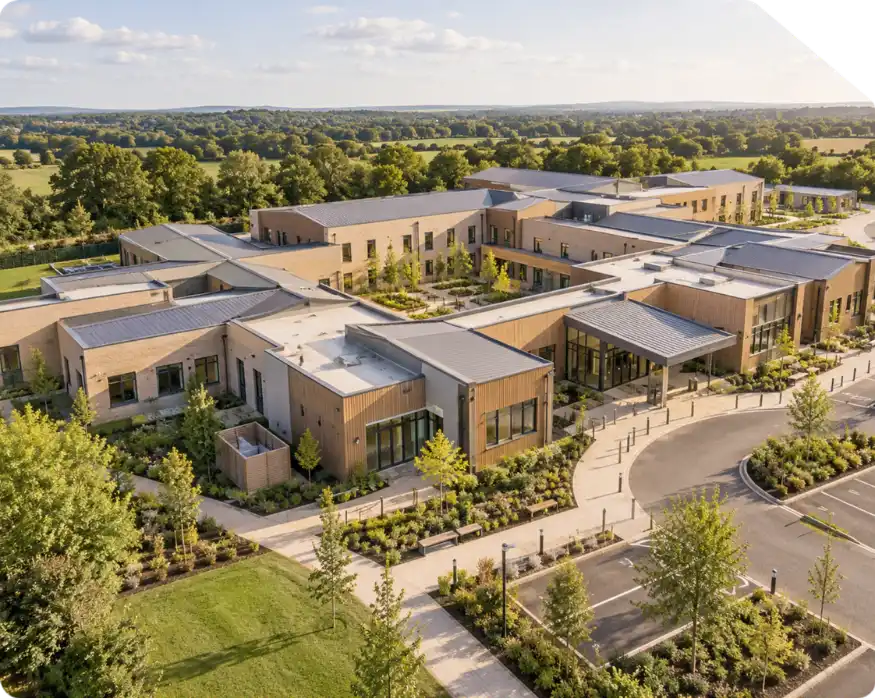
Two new-build specialist inpatient healthcare facilities had been designed around safety, durability and the needs of a demanding clinical environment.
The buildings were based on substantially the same plans, with one layout mirroring the other. They also shared the same unintended problem. Their structural design blocked the mobile network signal almost completely.
Dense blockwork, robust internal walls and secure ceiling construction significantly reduced the ability of outdoor mobile signals to reach the interior. Across substantial areas of the buildings, mobile phones could not maintain a reliable connection.
For the teams preparing to operate the facilities, this was an important consideration. Staff needed reliable mobile connectivity as they moved through wards, circulation routes and staff areas, without depending on every device being connected to the organisation’s Wi-Fi network.
Designing an in-building mobile coverage solution for the healthcare environment.
Scenariio worked with Nextivity technology to design an in-building cellular solution for both facilities.
The initial coverage design was developed from the building plans and considered:
- wall construction and its effect on signal propagation
- ward and staff-area layouts
- secure ceiling areas
- circulation spaces
- locations where reliable mobile connectivity was most important
The dense internal construction meant that standard theoretical coverage distances could not simply be applied across the buildings. Coverage units therefore had to be positioned around the actual characteristics and requirements of each space.
The aim was straightforward: provide dependable mobile coverage across priority areas while integrating the infrastructure discreetly into the new buildings.
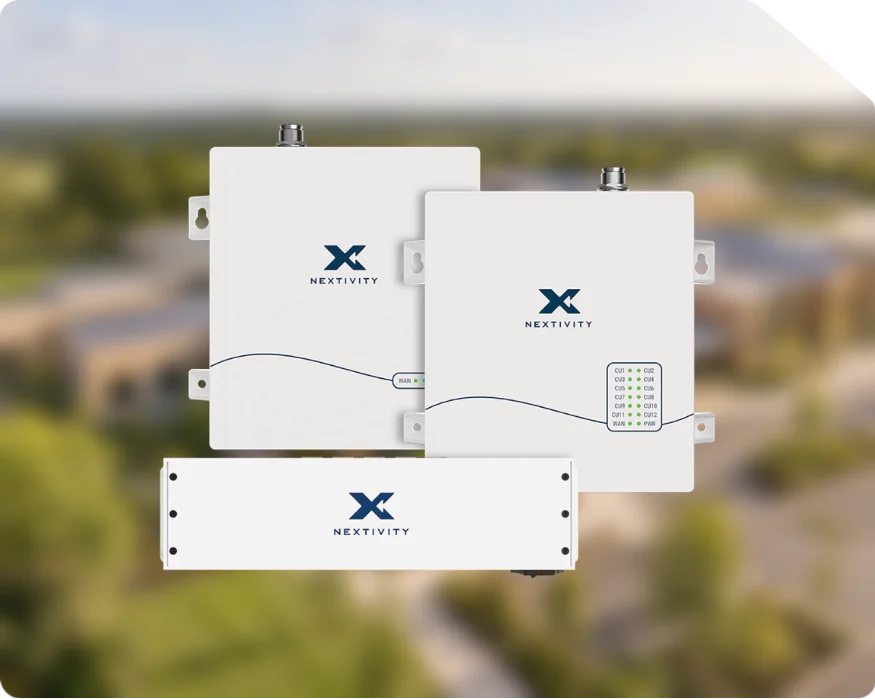
Installing the Nextivity CEL-FI QUATRA system.
The solution used Nextivity CEL-FI QUATRA technology to improve EE and Vodafone mobile coverage.
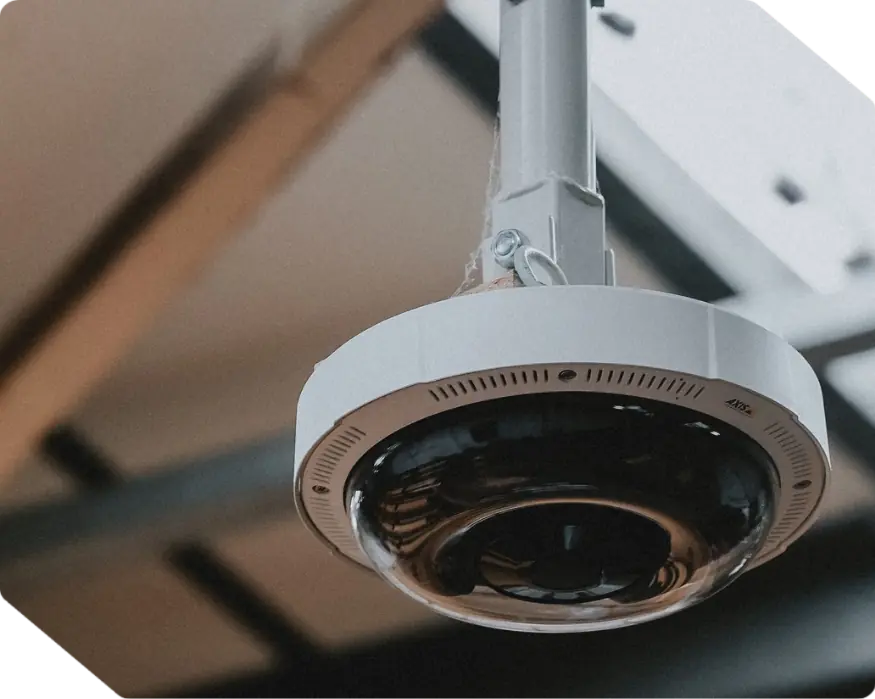
External antennas captured the available mobile signal outside the facilities and fed it into central equipment located within the building risers.
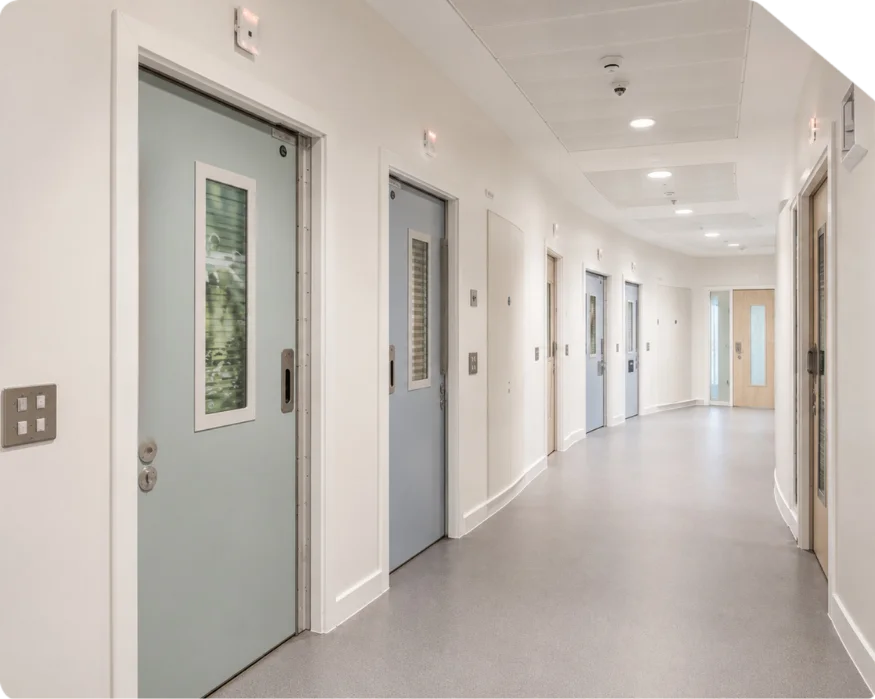
From there, Cat6A cabling distributed the service to coverage units positioned above the ceilings throughout the buildings.
Four rooftop antennas were positioned in opposing directions, enabling the system to receive available signal from different directions and adding resilience if the performance of a nearby mobile mast changed.
The solution included:
- Nextivity CEL-FI QUATRA
- EE and Vodafone mobile coverage
- external rooftop antennas
- Cat6A distribution infrastructure
- internal coverage units positioned throughout priority areas
- remote visibility of system performance
Delivering mobile coverage during the new-build construction programme.
Because the solution was installed before occupation, Scenariio could coordinate the cellular infrastructure with the wider construction programme.
That also introduced some practical constraints.
Access to different sections depended on the progress of the build, with some areas unavailable until preceding works had been completed. Much of the CEL-FI equipment also needed to sit above secure ceilings, making installation sequencing particularly important.
Once those ceilings were closed, access would become considerably more restricted.
Scenariio therefore coordinated the installation around the construction programme so that cabling, equipment and coverage units could be installed at the appropriate stage and the system fully commissioned before the facilities became operational.

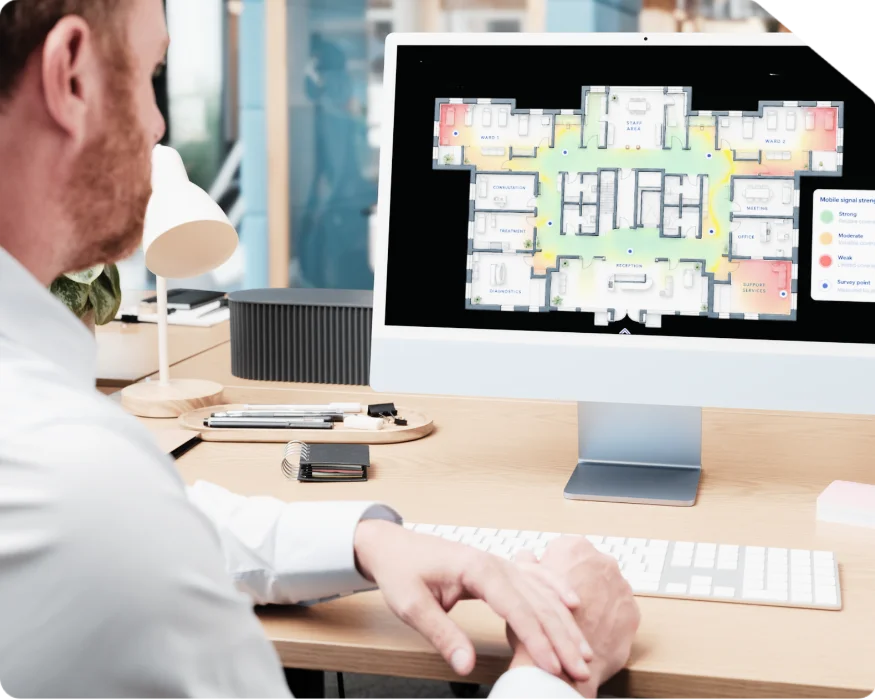
Testing mobile signal coverage before and after installation.
Testing provided a clear way to validate the performance of the solution. Scenariio surveyed the buildings with the CEL-FI system switched off and repeated the process with the system operating; the difference was clear.
Areas that had previously recorded little or no usable mobile signal gained coverage once the system was active. Testing confirmed strong coverage throughout the principal ward and staff areas, while also allowing any weaker locations to be identified before occupation.
This before-and-after approach provided evidence that the solution was addressing the original coverage problem rather than relying on theoretical design alone.
Project outcomes: improved mobile coverage across clinical and staff areas.
The completed installation delivered reliable mobile connectivity across the priority areas of both facilities.
Staff could use supported mobile networks throughout the main clinical and staff spaces without depending solely on access to the organisation’s Wi-Fi network.
Project outcomes:
- Improved EE and Vodafone coverage
- Reliable mobile calls and data across priority areas
- Reduced likelihood of calls dropping as staff moved through the buildings
- Mobile connectivity available independently of Wi-Fi access
- Remote visibility of system performance
- Flexibility to adapt the solution if additional mobile-network requirements emerged
The project also meant the buildings entered operation with their mobile connectivity requirements already addressed rather than discovering the problem after occupation.


Planning reliable mobile coverage into new healthcare buildings..
Mobile connectivity can easily be overlooked during building design, particularly where external network coverage appears satisfactory. However, the materials and construction methods used within a building can dramatically change the mobile experience indoors.
For new healthcare environments, considering cellular coverage alongside the wider building infrastructure creates an opportunity to incorporate antennas, cabling and coverage equipment before ceilings close and spaces become operational.
At Scenariio, we assess the environment first and design connectivity around how the building actually behaves and how people need to use it.
Where poor mobile signal is the issue, that may involve an in-building cellular system such as CEL-FI. Where the underlying problem lies elsewhere, the right solution may involve Wi-Fi, structured cabling, fibre or wider network infrastructure
Our team will respond and help you explore the most practical options.
FAQs
Dense walls, reinforced construction, specialist glazing, secure ceilings and modern insulation materials can all weaken or block mobile signals.
CEL-FI captures an available outdoor mobile signal and redistributes it through internal coverage units installed around the building.
No. Wi-Fi calling relies on the building’s Wi-Fi network. CEL-FI improves the mobile network signal itself.
Yes. The system can be designed to support one or multiple mobile networks, depending on the equipment selected and the project requirements.
Yes. New-build installation allows the system to be coordinated with cabling routes, risers, ceilings and other building services before occupation.
Yes. A retrofit usually begins with an internal and external mobile signal survey. Existing structured cabling may sometimes be used where capacity is available.
Yes. Remote visibility can be provided to support ongoing maintenance and system checks.
No. CEL-FI and Wi-Fi provide different types of connectivity and are commonly used alongside each other.