


Digital Communication Screens in Manufacturing Sector
News & Insights
Digital Communication Screens in Manufacturing: from Visibility to Real-Time Performance..
You can’t manage what you can’t see.
In food and drink manufacturing, where processes are tightly controlled and margins are under pressure, visibility is critical. Yet many sites still rely on fragmented communication, manual reporting and delayed insights.
Digital communication screens are changing that. Not as standalone displays, but as part of a connected, real-time operational environment.
Published
Monday, 30th March 2026
Category
News & Insights
TAGS
Insights
Turning data into action on the shop floor
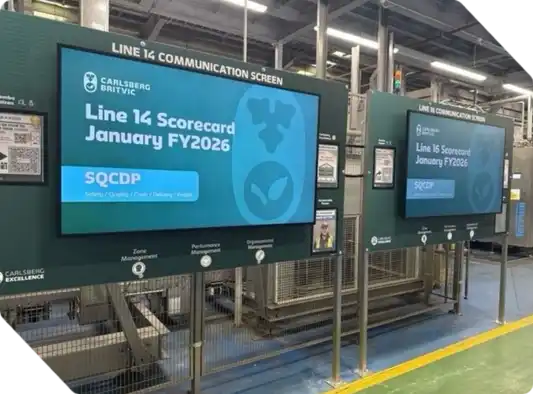
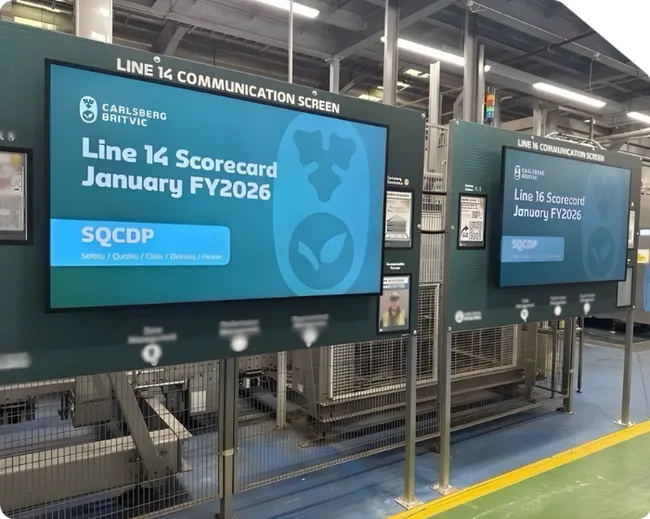
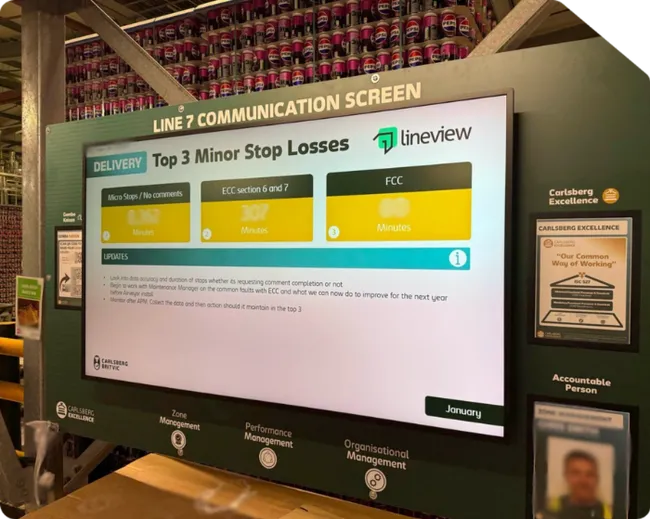
At Carlsberg Britvic, digital communication screens were deployed across the production environment to support a move towards a more connected, data-led operation.
Each screen provides real-time visibility of:
- KPIs and performance scorecards
- top losses and inefficiencies
- ongoing improvement initiatives
- daily operational updates
All structured around the SQCDP framework: Safety, Quality, Cost, Delivery and People.
This creates a shared view of performance across teams and shifts. More importantly, it enables faster, informed decision-making at the point of work.
From digital signage to smart factory integration
The real value of digital communication screens comes from integration. When connected to wider systems such as MES, IoT platforms or building infrastructure, screens become more than displays. They act as a live interface between data and people.
This enables:
- automated data feeds from production systems
- real-time updates without manual input
- consistent communication across lines and sites
- scalable deployment as operations grow
For facilities and IT teams, this shifts screens from isolated installations to part of a connected digital ecosystem.
Driving operational efficiency and continuous improvement
In manufacturing, visibility drives behaviour. By making performance data visible to everyone, digital communication screens support faster identification of issues, improved accountability across teams, alignment between departments and continuous improvement initiatives. For continuous improvement teams, visualising top losses and tracking progress daily is critical. For operators, it provides clarity on priorities during the shift.
The result is a more responsive, data-driven operation.
Avoiding “white noise”: making screens part of daily operations
A common concern with digital communication screens is that they risk becoming background noise. In some environments, screens are installed with good intent but fail to influence behaviour. Over time, teams stop engaging with them and the value is lost. The difference comes down to how they are embedded into daily operations.
At Carlsberg Britvic, the screens are structured around SQCDP, which already underpins how teams review performance on the shop floor. Rather than introducing new layers of information, the screens reinforce what matters, making it visible, consistent and real time.
To ensure the information remains relevant and actionable:
- content is specific to each production line or area
- data is live, allowing teams to see changes during the shift
- screens are positioned where team discussions naturally take place
- they support daily huddles and reviews, rather than replacing them
When digital communication screens become part of the operating rhythm, they shift from passive displays to practical tools that support decision-making on the floor.
Digitalisation in UK manufacturing: from pilot to scale
Digitalisation in UK manufacturing is not a new concept. Programmes such as Made Smarter began as regional pilots in 2018, demonstrating the value of technologies including real-time data, IoT and connected systems. Since then, the focus has shifted from experimentation to national rollout and wider adoption.
Today, that rollout is accelerating. Government-backed programmes are expanding across all English regions by 2025–26, with further UK-wide adoption expected beyond that. For manufacturers, the priority is no longer whether to adopt digital tools, but how to embed them into day-to-day operations at scale. In this context, digital communication screens play a practical role. They ensure that data generated across systems is visible and usable on the shop floor.
The Scenariio approach
At Scenariio, digital communication screens are delivered as part of a wider, integrated solution. This means aligning AV, network and data infrastructure, integrating with existing production and building systems and designing for scalability across sites. The focus is on creating a communication layer that supports operational performance.
Conclusion
In food and drink manufacturing, digital communication screens are a practical tool for improving visibility, driving performance and enabling real-time decision-making. As manufacturing continues to digitalise, their role will become more central. Not as standalone technology, but as part of how modern factories operate.
FAQ
Digital communication screens are strategically placed displays across the factory floor that provide live operational data, performance metrics and team communication.
In modern manufacturing environments, they sit at the intersection of digital signage, production systems and smart factory infrastructure.
Their role is simple. Make critical information visible, consistent and actionable.
Digital signage is often used for general messaging or corporate communication.
Digital communication screens in manufacturing are typically integrated with operational systems and display live production data.
They can integrate with systems such as:
- MES (Manufacturing Execution Systems)
- IoT platforms
- ERP systems
- building or infrastructure platforms
Integration enables automated, real-time updates.
Key benefits include:
- improved visibility of performance
- faster decision-making
- better team alignment
- support for continuous improvement
- more consistent communication across shifts.
Screens can become ineffective if:
- content is not relevant to the audience
- data is outdated or manual
- they are not used in daily routines
- there is no ownership of the content
Embedding them into existing processes is critical. Speak to us if any of these is your concern.
Yes. They can support compliance by reinforcing safety, hygiene and quality messaging in real time and ensuring consistent communication across teams.
There are no strict mandates, but programmes such as Made Smarter are accelerating digital adoption across manufacturing, supported by funding and advisory initiatives.
