





Scenariio sponsors beehive at Shropshire's historic Conduit Head Apiary
News & Insights
Scenariio sponsors beehive at Shropshire's historic Conduit Head Apiary.
by Magdalena Thackeray, Marketing Manager at Scenariio
Published
Wednesday, 14th October 2026
Category
News & Insights
TAGS
Company News
Scenariio is supporting Shropshire Beekeepers' Association through a beehive sponsorship, contributing to the organisation's work in beekeeping education, conservation and community engagement.
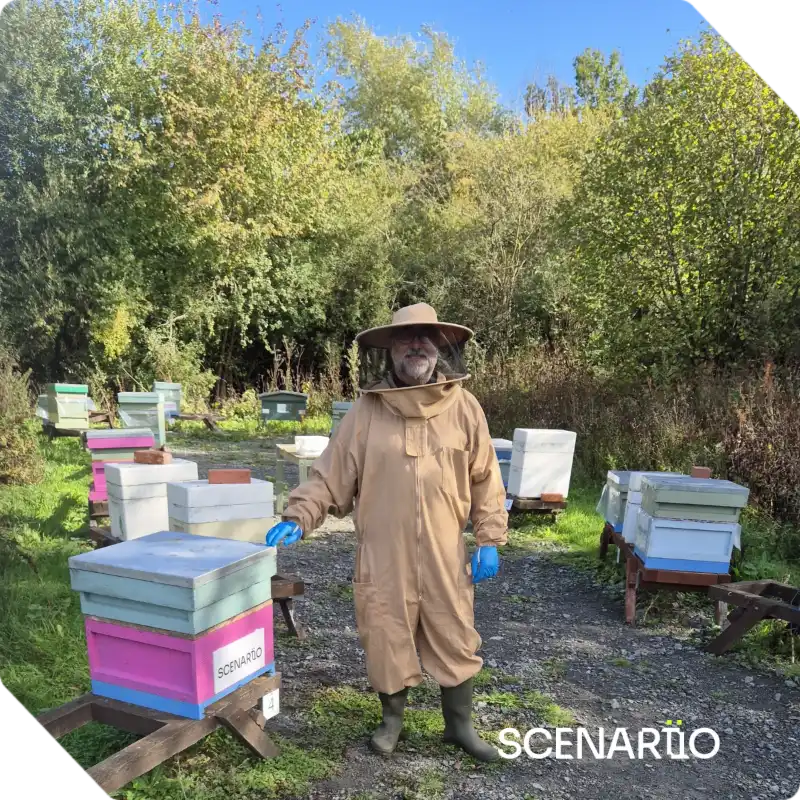
Our Commercial and Sales Director, Lee Taylor, recently visited Conduit Head Apiary in Shrewsbury for a hive-naming event and an introduction to the fascinating world of beekeeping.
During his visit, Lee met with John Adams, Chair, Education Lead and ADM Representative at Shropshire Beekeepers’ Association, and Emma Woodhouse, Health and Safety Consultant at Walker Health and Safety Services Limited, who introduced the sponsorship opportunity to Scenariio.
Despite some initial reservations about finding himself surrounded by thousands of bees, Lee thoroughly enjoyed the experience.
Getting to know our new buzzing friends
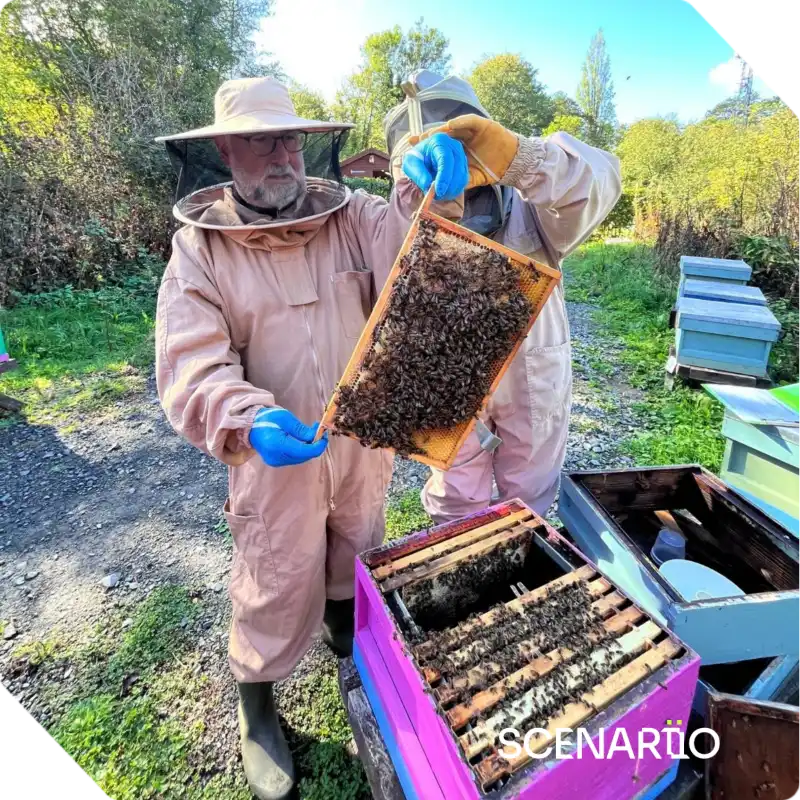
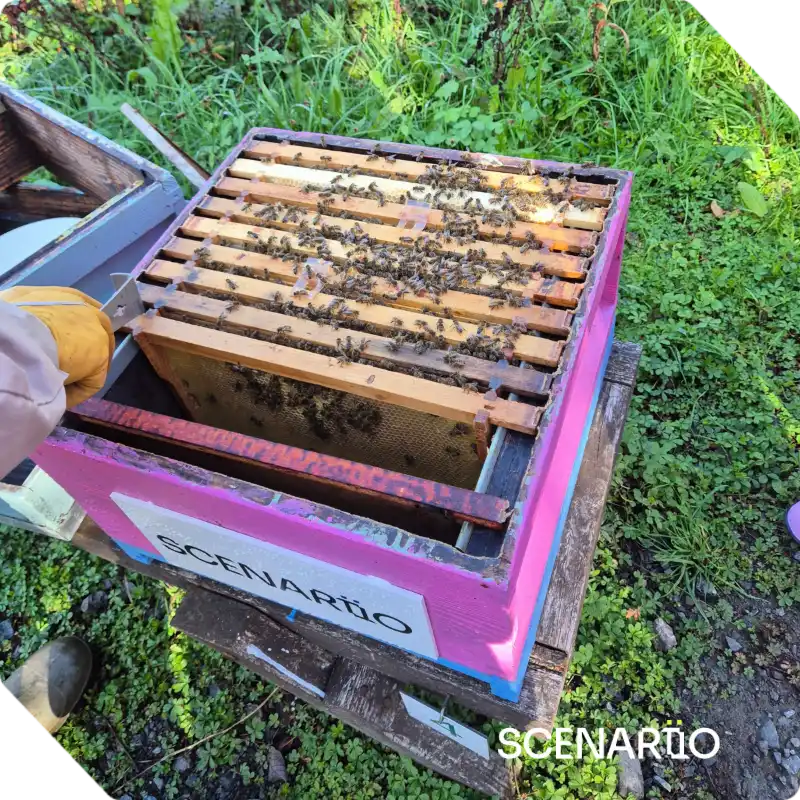
Equipped with a protective suit and gloves that looked rather thinner than expected, Lee joined the association’s experienced beekeepers for a closer look inside the hive. As the frames were carefully lifted, he was able to observe thousands of bees at work and learn about how the colony operates. What surprised him most was how peaceful the experience felt.
“It is very peaceful. It’s like you’re at one with nature,”
Lee recalled
His initial apprehension soon disappeared, replaced by a genuine appreciation for the bees and the people who care for them.
A remarkable place with centuries of history
The visit also introduced Lee to the fascinating history of Conduit Head.
The site has a long association with Shrewsbury’s water supply, dating back to Tudor times. Following a period of neglect, Shropshire Beekeepers’ Association and its volunteers have worked to restore the grounds and make the area’s history accessible to visitors.
Today, the working apiary sits alongside historic wells, wooden walkways, a pond and habitats supporting local wildlife. Lee was particularly impressed by the care that has gone into the site and the enthusiasm of the volunteers sharing their knowledge.
Take a closer look at Lee’s visit
We’ve put together a short photo slideshow capturing Lee’s visit to Conduit Head Apiary, including a closer look inside the hive and some of the fascinating surroundings.
Head over to our LinkedIn page.
Supporting local initiatives
Sustainability is one of Scenariio’s core values, reflected in the technologies we deliver and the initiatives we choose to support. Sponsoring a beehive gives us an opportunity to contribute to the association’s ongoing work and support the volunteers who dedicate their time to beekeeping education and caring for the site.
Lee returned with plenty of photographs, some locally produced honey and a recommendation for other businesses considering similar sponsorships. He encourages organisations to get in touch with their local beekeeping associations and explore opportunities to support their work.
Our thanks go to Emma, John and everyone at Shropshire Beekeepers’ Association for their warm welcome, their enthusiasm and the excellent work they do.
To learn more about the association, visit shropshirebees.co.uk
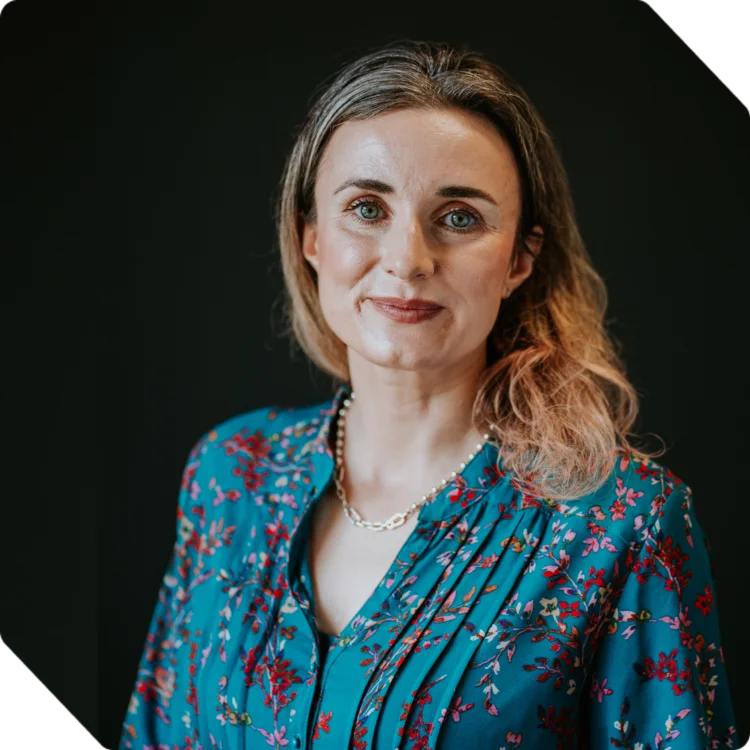
This post was written by Magdalena Thackeray, Marketing Manager at Scenariio.
Magdalena Thackeray has worked in marketing for almost 15 years and is a bit of a one-woman band, enjoying everything from storytelling and content to creating engaging customer experiences across different media.
Working in the built environment has given her a particular fascination with the technology operating quietly behind the scenes. She is continually amazed by how much impact it can have — helping organisations improve sustainability while creating spaces that support collaboration, wellbeing, productivity and the people who use them every day.
Outside work, Magdalena is an avid piano learner and video games enthusiast.

Scenariio to host East Midlands Chamber networking breakfast
News & Insights
Scenariio to host East Midlands Chamber networking breakfast at Innovation House.
by Magdalena Thackeray, Marketing Manager at Scenariio
Published
Thursday, 1st October 2026
Category
News & Insights
TAGS
Company News
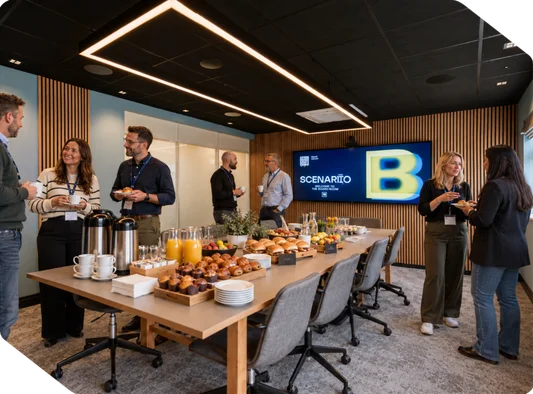
We’re opening the doors to Innovation House this October as we host an East Midlands Chamber Chamber Connect Networking Breakfast for businesses from across the region.
Taking place on Friday 16 October, the morning will bring Chamber members together at our Derby headquarters for breakfast, new connections and a closer look at the technology behind a modern, integrated workplace.
Networking with a difference
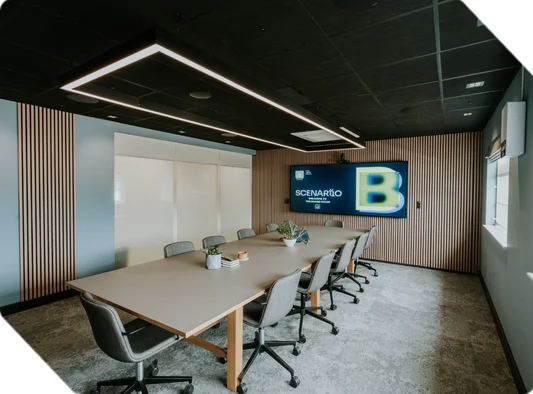
There will, of course, be plenty of time to meet other businesses and start new conversations. But we also wanted to give our guests the chance to properly experience Innovation House. Our Derby headquarters was designed as a working example of the approach we take with our customers.
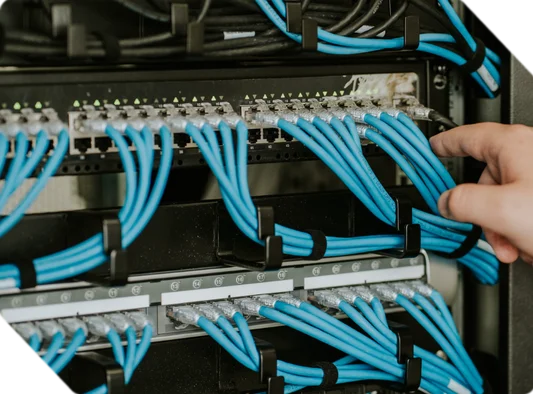
It starts with the foundations: modern structured data cabling, fibre and network infrastructure. From there, technologies including audio visual systems, smart lighting, sensors, security, access control and building analytics can be integrated across the workplace.
The important part is how those technologies work together. When infrastructure and workplace systems are considered as a whole, the office becomes simpler to use and manage, while supporting comfort, collaboration and productivity. Ultimately, it helps create the kind of workplace where people actually want to spend their time.
Guests will be able to see that approach in action during a tour of Innovation House, rather than simply hearing us talk about it. And yes, there will also be an opportunity to see your own business on the big screen.
Early access for Chamber members
We’ll also be using the morning to introduce a new Member to Member offer for East Midlands Chamber members.
Guests attending the event will be among the first to hear the details and will receive early access to the offer before we share it more widely with the Chamber community.
Join us at Innovation House
The morning starts with registration and breakfast at 9.00am, followed by welcomes from East Midlands Chamber and Scenariio, a tour of Innovation House and plenty of time for networking. The event closes at 11.00am.
Spaces are limited, so if you’re an East Midlands Chamber member and would like to meet more businesses from across the region, while having a look around a rather different kind of office, we’d love to welcome you to Innovation House.
Friday 16 October 2026
9.00am – 11.00am
Innovation House, Riverside Park, Raynesway, Derby
This post was written by Magdalena Thackeray, Marketing Manager at Scenariio.
Magdalena Thackeray has worked in marketing for almost 15 years and is a bit of a one-woman band, enjoying everything from storytelling and content to creating engaging customer experiences across different media.
Working in the built environment has given her a particular fascination with the technology operating quietly behind the scenes. She is continually amazed by how much impact it can have — helping organisations improve sustainability while creating spaces that support collaboration, wellbeing, productivity and the people who use them every day.
Outside work, Magdalena is an avid piano learner and video games enthusiast.
Structured Cabling Solutions: 40 Years with CommScope
News & Insights
A CommScope Partnership Built Over Four Decades.
by Rob Pritchard, Founder and Managing Director at Scenariio
Published
Monday, 21st September 2026
Category
News & Insights
TAGS
Company News
My association with the SYSTIMAX® and CommScope family spans almost 40 years and, in truth, predates the CommScope name itself.
Over that time, I have watched one of the networking industry’s most respected brands evolve from Western Electric and AT&T, through Lucent Technologies and Avaya, to CommScope and, most recently, to Amphenol, which acquired CommScope’s Connectivity & Cable Solutions business in 2026.
Looking back, I have been fortunate to witness much of that journey first-hand.
That history continues today. Scenariio has recently become the first company in the UK to achieve CommScope’s new GigaREACH™ XL installer certification. GigaREACH XL itself is already very familiar to us and has been used across many of our projects. What is new is the dedicated certification, providing formal recognition of the design, installation and testing knowledge behind the solution.
From the Early Days of Structured Cabling
In the late 1980s and early 1990s, I was involved in some of the earliest AT&T Premises Distribution System (PDS) Category 3 structured cabling deployments, many of them designed to support IBM Token Ring networks. For those who remember Token Ring, it was cutting-edge technology at the time and represented the future of enterprise connectivity. While the technology itself has long since disappeared, the principles established by those early structured cabling systems remain the foundation of modern network infrastructure.
Building Scenariio’s CommScope Partnership
When Scenariio was founded in 2013, becoming a CommScope Partner was a natural decision. It built upon decades of experience designing and delivering structured cabling solutions and an appreciation of the engineering standards that have consistently distinguished the SYSTIMAX platform throughout its various ownerships and evolutions.
Today, Scenariio has delivered 100s of certified warrantied CommScope sites, placing us among the UK’s most experienced CommScope Premier Solution Providers. Those projects span multiple sectors, building types and technologies, all sharing a common requirement: robust, reliable physical infrastructure capable of supporting business-critical applications for years to come.
Why Structured Cabling Should Never Be a Commodity Purchase
The reason we have remained committed to the platform throughout its evolution is simple. We have never viewed structured cabling as a commodity purchase. The true value lies not in the cable itself, but in the design, installation, testing, documentation and long-term assurance behind it. A network’s performance ultimately depends upon the quality of its physical foundation.
The Backbone of the Modern Intelligent Building
That principle has become even more important as buildings have become increasingly connected. What was once a network supporting voice and data now underpins wireless connectivity, CCTV, access control, audiovisual systems, environmental sensors, building management systems, lighting and smart workplace technologies. The structured cabling infrastructure has become the backbone of the modern intelligent building.
We have often been early adopters where new infrastructure technologies solve a genuine customer problem. Scenariio was the first company in the UK to install CommScope’s Powered Fiber solution, now known as FiberREACH™. Since that first deployment, we have become the UK’s largest installer and network designer of the solution, using it to take both power and high-speed data far beyond the distances possible with conventional copper infrastructure.
One of the key strengths of the CommScope and SYSTIMAX ecosystem has always been its focus on engineering excellence and compatibility across multiple technologies. That philosophy aligns closely with Scenariio’s approach. We look beyond individual systems to understand how technologies can work together to create smarter, more efficient and more productive environments.
The SYSTIMAX Story Continues
The recent transition to Amphenol ownership represents another chapter in a remarkable history. From AT&T’s pioneering PDS architecture and the launch of SYSTIMAX in 1989, through Lucent, Avaya and CommScope, the platform has consistently adapted to changing technologies while maintaining its reputation for innovation and reliability. Today, under Amphenol, that legacy continues into the next generation of fibre, connectivity and intelligent infrastructure solutions.
What Four Decades of Experience Teaches You
I have also been privileged to receive a CommScope Lifetime Achievement Award, recognition of a career spent helping organisations navigate more than four decades of technological change. While such recognition is appreciated, the real value comes from experience: understanding how networks evolve, how buildings change and how infrastructure decisions made today continue to affect performance many years into the future.
Across almost four decades, the technology has changed beyond recognition. The journey from Category 3 cabling and Token Ring networks to multi-gigabit Ethernet, smart buildings and AI-enabled data centres has been extraordinary. Yet one principle has remained remarkably consistent:
Design the infrastructure properly, install it properly and give the customer something they can depend on for the long term.
That philosophy has guided my relationship with the SYSTIMAX, CommScope and now Amphenol family for nearly 40 years and continues to underpin everything we do at Scenariio.
Marketing Derby kindly shared our news about GigaReach certification – you can read the article here.

This post was written by Rob Pritchard, Founder and Managing Director of Scenariio.
Rob has almost 40 years’ experience in structured cabling, network infrastructure and smart building technology. His career spans the evolution of enterprise networking from early AT&T PDS systems to today’s high-performance fibre, powered connectivity and intelligent building environments. He founded Scenariio in 2013 and has since helped organisations across the UK design reliable infrastructure that can support changing technology for the long term.

Scenariio Maintains Avetta Assessed Contractor Status
News & Insights
Scenariio Maintains Avetta Assessed Contractor Status.
Choosing a technology contractor involves more than reviewing a system design, specification or price. Before work begins, clients need evidence that a supplier has the right competence, processes and insurance in place. They also need confidence that risks will be understood, site requirements followed and responsibilities kept clear throughout delivery.
Published
Wednesday, 8th August 2026
Category
News & Insights
TAGS
Company accrediations
Scenariio continues to maintain its Avetta Assessed status, providing independently assessed evidence of the health and safety arrangements supporting our work.
Scenariio continues to maintain its Avetta Assessed status, providing independently assessed evidence of the health and safety arrangements supporting our work. The status reflects standards already embedded across the business and maintained through our day-to-day operations.
“Clients need confidence in the way a contractor operates before work begins, particularly on complex or operational sites. Maintaining our Avetta Assessed status reflects the standards we expect across the business and the care our teams take when planning, managing and delivering each project.”
Rob Pritchard, Managing Director at Scenariio
Why UK Businesses Assess Contractors Before Appointment
Contractor prequalification is not simply an administrative exercise. It helps organisations understand whether a supplier is prepared to enter their sites, manage its responsibilities and carry out the work safely.
The Health and Safety Executive advises businesses using contractors to identify the work clearly, select a suitable contractor, assess the risks, exchange relevant information and manage and supervise the activity. Appointing another company does not remove the client’s responsibilities for the work taking place on its premises.
For larger estates, operational facilities and multi-site programmes, a structured prequalification process can also reduce repeated requests for the same company-level evidence. Current insurance, competence records and health and safety arrangements can be reviewed before project-specific mobilisation begins.
UK Contractor Competence Requirements Under CDM 2015
Where work falls within the Construction (Design and Management) Regulations 2015, commonly known as CDM 2015, those appointing contractors must take reasonable steps to ensure they have the necessary skills, knowledge and experience. When the appointment is an organisation, it must also have the organisational capability required to perform its role safely.
This is particularly relevant to building technology projects. CDM 2015 defines construction work broadly and includes the installation, commissioning, maintenance, repair or removal of fixed electrical, telecommunications, computer and similar building services. The precise duties depend on the scope and circumstances of each project, but cabling, smart building, audiovisual and security installations should not be treated as separate from wider construction planning simply because the finished technology may be discreet.
What Organisational Capability Means in Practice
Organisational capability reaches beyond the technical ability of an individual engineer. It concerns whether the company has suitable people, resources and management arrangements to plan, manage and monitor the work.
• Defined health and safety responsibilities
• Competent and appropriately trained personnel
• Processes for risk assessments and method statements
• Effective project planning, coordination and supervision
• Controls for subcontractors and specialist partners
• Current insurance, certification and supporting records
• Incident reporting, corrective action and continual improvement
• Accurate commissioning, handover and project documentation
These arrangements are particularly important in occupied buildings, live industrial environments and sites where several contractors depend on one another. Missing evidence, expired records or unclear responsibilities can delay onboarding and access. Weak planning can also create disruption, rework and unmanaged risk once installation begins.
How Avetta Supports Contractor Prequalification and Due Diligence
Avetta provides a platform through which organisations can collect, review and monitor supplier information. Depending on the client, work category and risk profile, this may include health and safety arrangements, insurance, certification and other compliance evidence.
Maintaining our Avetta Assessed status helps Scenariio demonstrate that the applicable company-level foundations supporting safe delivery remain current. For clients using Avetta, it can provide greater visibility during supplier due diligence and make the early stages of onboarding more efficient.
Avetta does not replace the judgement required when appointing a contractor. It also does not replace site surveys, project-specific risk assessments, method statements, inductions, permits or supervision. Those controls must still reflect the actual work and conditions found on each site.
How Avetta Assessed Relates to SSIP
Avetta Assessed is a Registered Member of Safety Schemes in Procurement, known as SSIP. The certificate confirms that a supplier has undergone a desktop assessment against the SSIP Core Criteria for the applicable category.
SSIP provides a common approach to occupational health and safety assessment and supports mutual recognition between registered member schemes. This can reduce duplication, while allowing clients to request further evidence where a project, site or supply chain introduces additional requirements.
What Avetta Assessed Status Means for Scenariio Clients
Our maintained status gives procurement, health and safety, estates and project teams another source of evidence when assessing Scenariio as a technology partner.
• Recognised assessment of relevant health and safety arrangements
• Current supporting company and insurance information
• Greater visibility during supplier prequalification
• Established processes for managing competence and risk
• Additional assurance before project-specific planning begins
The practical value is greatest when this evidence supports good project preparation. Clear information and responsibilities allow potential gaps to be addressed earlier, helping teams prepare for site access and mobilisation without unnecessary last-minute requests.
Managing Technology Projects in Live and Operational Environments
Scenariio delivers IT infrastructure, smart building, audiovisual and physical security projects across commercial workplaces, education estates, manufacturing and logistics facilities, healthcare settings, public buildings and construction environments.
A single programme may involve structured cabling, fibre, smart lighting, sensors, CCTV, access control, audiovisual systems and connections to wider building platforms. Installation may take place while a site remains occupied or alongside facilities teams, construction partners and other specialist contractors.
Our project teams assess those conditions and coordinate delivery around the wider environment. This can involve phased installation, restricted working hours, controlled areas, operational dependencies and careful planning around the people using the building.
“Good compliance supports better project delivery. When information, responsibilities and site requirements are clear from the outset, teams can mobilise more effectively, manage risk properly and reduce preventable delays. Maintaining our Avetta Assessed status helps demonstrate that these processes are firmly in place.”
Dean Martin, Scenariio Senior Project Manager
How Scenariio Maintains Contractor Compliance Standards
Compliance has value when the standards behind it remain active. Policies need to reflect how the business operates. Training and competence records must be managed. Insurance and certification need to stay current. Processes must also be applied consistently when projects become busy or site conditions change.
Maintaining Avetta Assessed status forms part of this ongoing work. It is not a one-off registration exercise or a badge collected for display. It provides a point of independent scrutiny within a wider management approach focused on reliable delivery and continual improvement.
Scenariio’s UK Compliance Certifications and Accreditations
Avetta sits alongside other independently assessed standards and credentials held by Scenariio:
• ISO 9001, supporting quality management and continual improvement
• ISO 14001, supporting environmental management
• Cyber Essentials, demonstrating fundamental cybersecurity controls
• SafeContractor, providing further contractor health and safety assurance
• Avetta Assessed status, supporting supplier prequalification and SSIP assessment
Each examines a different part of our operations. Together, they give clients a broader view of how Scenariio manages quality, safety, environmental responsibilities, information security and project delivery.
The project controls behind a reliable technology installation
Clients see the finished outcome: a reliable network, an effective meeting room, a secure site or a building where several technology systems work together.
Behind that result sit surveys, designs, competence checks, risk assessments, method statements, project programmes, change control, commissioning records and accurate handover information. These disciplines reduce uncertainty, support accountability and help projects move from specification to installation with fewer surprises.
Maintaining our Avetta Assessed status gives clients further assurance that these foundations remain in place before they entrust Scenariio with their sites, infrastructure and technology.
Choose an Avetta Assessed UK technology contractor
Scenariio designs, installs, integrates and supports technology across buildings and operational estates. From early infrastructure planning through to installation, commissioning and ongoing support, we bring multiple technology layers together under one accountable project structure.
FAQs
Yes. Scenariio maintains Avetta Assessed status as part of our commitment to health and safety, contractor compliance and dependable technology project delivery.
Avetta is a supply-chain risk management and contractor prequalification platform. Clients use it to collect, review and monitor supplier information, which can include health and safety arrangements, insurance, certification and other compliance evidence.
Avetta Assessed is a UK contractor assessment scheme and a Registered Member of Safety Schemes in Procurement, known as SSIP. A certificate confirms that the supplier has undergone a desktop assessment against the applicable SSIP Core Criteria.
Yes. Avetta Assessed is an SSIP Registered Member scheme. It supports mutual recognition between SSIP member schemes for the relevant certified assessment categories.
Businesses assess contractors to understand whether they are competent, appropriately insured and able to manage the risks connected with their work. HSE guidance also expects organisations using contractors to select suitable suppliers, exchange information and manage and supervise the activity.
CDM 2015 requires contractors to have the necessary skills, knowledge and experience. Where the contractor is an organisation, it must also have the organisational capability needed to carry out its role safely.
They can be. CDM 2015 includes the installation, commissioning, maintenance, repair or removal of fixed electrical, telecommunications, computer and similar building services within its definition of construction work. Applicability should be considered against the actual scope and setting of each project.
Organisational capability means that a business has appropriate policies, systems, competent people and resources to perform its role safely. Evidence can include training arrangements, project controls, supervision, subcontractor management, risk processes and records showing how work is planned and monitored.
No. Avetta registration is not a general legal requirement for every UK contractor. Some organisations nevertheless require suppliers to complete Avetta prequalification before joining an approved supply chain, tendering for work or accessing a site.
No. Avetta can support contractor prequalification, but it does not replace the responsibilities held by clients, designers, principal contractors or contractors under CDM 2015. Project-specific information, planning and controls are still required.
No. Company-level assessment does not replace project-specific risk assessments and method statements. RAMS should reflect the actual work, location, equipment, people and hazards involved and should be reviewed when conditions or scope change.
Yes. Avetta can support onboarding by giving clients a central process for reviewing and monitoring relevant supplier information. Individual organisations and projects may still request additional evidence.
Not automatically. Requirements can vary by client, work category, site and level of risk. A supplier may satisfy its applicable assessment requirements and still need to provide further project-specific evidence.
Scenariio also holds ISO 9001, ISO 14001, Cyber Essentials and SafeContractor credentials. Together, these support quality management, environmental responsibility, cybersecurity, contractor health and safety and project delivery.
Clients can request current certification and compliance information directly from the Scenariio team. Organisations connected with Scenariio through Avetta may also be able to review relevant supplier information through the platform.
ISO Certified Project Management Specialists
News & Insights
ISO Certified Project Management Specialists for Connected Technology Projects.
Scenariio has maintained ISO 9001 and ISO 14001 certification for another year, reinforcing its commitment to quality, environmental responsibility and continual improvement.
Published
Monday, 9h July 2026
Category
News & Insights
TAGS
Insights
Every successful project needs a clear way of working. On technology projects, that structure matters early. It shapes how information is captured, how decisions are recorded, how risks are managed and how teams stay aligned from survey to handover.
This is especially important when projects bring together IT infrastructure, smart building systems, audio visual technology, software, suppliers, site teams and client stakeholders. Following its latest external audit, Scenariio has successfully maintained both ISO 9001 and ISO 14001 certification for another year. The recertification confirms that Scenariio continues to meet recognised standards for quality management and environmental management.
For clients, partners and suppliers, it provides confidence that Scenariio has structured systems in place to manage quality, reduce environmental impact and keep improving the way projects are delivered.
Why ISO certification matters in project management
When a project involves several technologies, sites or stakeholders, the process behind the work can directly affect the outcome.
Clear processes help project teams manage responsibilities, technical information, supplier activity, risk, change and handover. They also make it easier to review what worked well and where improvements can be made.
At Scenariio, process is there to make projects clearer, not heavier. It gives clients confidence that the right steps are being followed, the right information is being captured and the right people are accountable at each stage.
ISO 9001 certified project management and quality assurance
ISO 9001 supports the way Scenariio plans, delivers, reviews and improves its work.
For clients looking for an ISO certified project management specialist, this means Scenariio can evidence a structured approach to quality management. This includes project delivery, supplier management, customer service, internal review and continual improvement.
Quality is shaped throughout a project. It starts with the way requirements are understood and continues through design, planning, installation, communication, documentation, handover and support.
This is important for technology projects delivered in live environments, operational buildings or multi-stakeholder sites where consistency and accountability are essential.
ISO 14001 certified project delivery and environmental management
Scenariio has also maintained ISO 14001 certification, which recognises its approach to environmental management.
ISO 14001 provides a framework for managing environmental impact across business operations. This includes areas such as energy use, waste reduction, procurement, resource efficiency and continual improvement.
For Scenariio, environmental responsibility is closely linked to the work delivered for clients. As a smart building system integrator, Scenariio works with technologies that help organisations understand and manage their buildings. This includes energy monitoring, smart lighting, occupancy insights, environmental sensors and building performance data.
Maintaining ISO 14001 reinforces Scenariio’s commitment to applying environmental management principles within its own operations while supporting clients with technology that can improve building performance.
How Scenariio processes support successful projects
Scenariio delivers connected technology projects across IT infrastructure, smart building solutions, audio visual system integration and professional services.
These projects often require networks, cabling, sensors, lighting, security, AV, software platforms and building data to work together in one environment.
Strong processes help reduce project risk. They support communication, improve consistency and make it easier to manage quality from early planning through to installation, handover and ongoing support.
The latest ISO 9001 and ISO 14001 recertification gives clients additional assurance that Scenariio’s approach is independently assessed and aligned with recognised management systems.
A commitment to continual improvement
ISO 9001 and ISO 14001 are not one-off achievements. They require ongoing review, evidence and improvement.
For Scenariio, maintaining both certifications reflects the work taking place across the business to strengthen processes as the company continues to grow.
The recertification follows a period of continued development for Scenariio, including the launch of its new website and the move into its new Derby headquarters at Innovation House.
Good delivery needs structure. When a project involves several systems, suppliers and stakeholders, clients need to know that decisions, risks and responsibilities are being managed properly. Maintaining ISO 9001 and ISO 14001 helps us evidence that approach and keep improving as the business grows.
Rob Pritchard, Managing Director at Scenariio
Speak to an ISO certified project management specialists
Scenariio helps organisations deliver connected technology projects with structure, clarity and confidence.
From IT infrastructure and smart building solutions to audio visual systems and professional services, the Scenariio team can support your next project from early planning through to delivery and ongoing support.
FAQs
ISO 9001 is a quality management standard. It helps organisations demonstrate that they have processes in place to manage quality, meet customer requirements, review performance and improve over time.
ISO 14001 is an environmental management standard. It helps organisations manage environmental responsibilities through a structured framework covering areas such as resource use, waste, procurement, compliance and continual improvement.
Yes. Scenariio has maintained ISO 9001 Quality Management certification and ISO 14001 Environmental Management certification following its latest external audit.
ISO certification gives clients confidence that recognised management systems are in place. For project management, this helps evidence how quality, risk, responsibilities, supplier activity, communication and improvement are managed.
ISO 9001 supports project management by encouraging clear processes, documented responsibilities, customer focus, performance review and continual improvement. For Scenariio, it supports consistency from survey and design through to installation, handover and support.
ISO 14001 supports sustainable project delivery by giving organisations a framework to manage environmental impact. For Scenariio, this supports internal environmental management as well as work involving energy monitoring, smart lighting, occupancy data and building performance technology.
Scenariio delivers IT infrastructure, smart building solutions, audio visual system integration and professional services. This includes connected technology projects across commercial offices, education, healthcare, logistics, manufacturing and public sector environments.
What happens after the smart building project goes live
News & Insights
What Happens After the Smart Building Goes Live
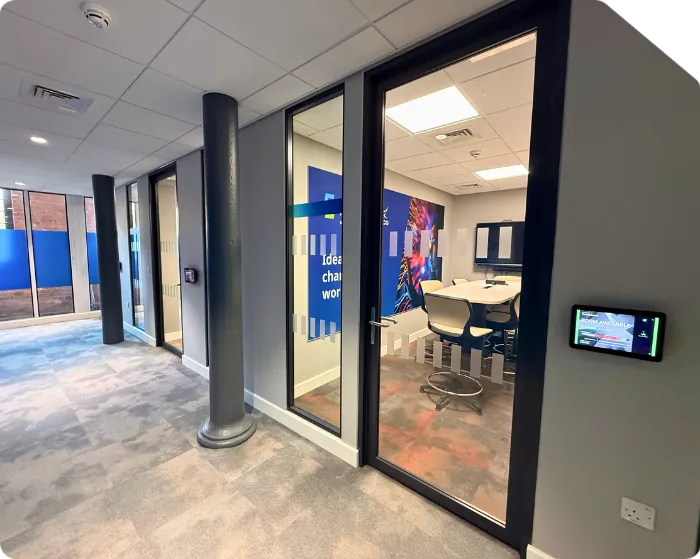
When the Derby College Business Centre first opened, success was measured in familiar ways. The technology worked, rooms could be booked, lighting adjusted automatically and hybrid meetings finally ran smoothly across campuses. From a delivery perspective, the project did what it set out to do.
What was less obvious at the beginning was how long it would take for the space to settle and how much of its real value would only become visible once people had time to adapt.
Published
Monday, 29th June 2026
Category
News & Insights
TAGS
Insights
Three years on, the Business Centre offers a useful reminder that smart buildings rarely deliver their full impact at handover. They do it gradually, through adoption, habit and behaviour.
When technology becomes part of the environment
As Ian McCormick, IT Director at Derby College Group, reflects:
“At the start, you’re focused on getting the space delivered.
Three years later, you start to understand what it’s actually changed.”
One of the clearest indicators of success is how naturally the Business Centre now supports day-to-day activity across the college. The lighting adjusts throughout the day in response to occupancy and time, hybrid meetings happen routinely and rooms are booked through familiar tools like Outlook and Microsoft Teams.
Most people don’t think about the technology behind it anymore. It has simply become part of how they expect the environment to work.
“People don’t really notice the lighting changing, it just feels right.”
Ian says.
That shift matters. Rather than becoming outdated, the technology has settled into everyday use in a way that feels consistent and dependable.
Designing spaces around how people actually work
From the beginning, the Business Centre was designed around clear intent. Different areas were created to support different types of activity, rather than trying to make every space do everything equally well. That approach has become more valuable over time.
“You can’t mix contemplation and collaboration and expect the space to work,”
Ian explains.
Creating clearer distinctions between focused work, meetings and informal collaboration has helped people understand how to use the environment more effectively. It has also influenced how other projects across the college are now approached. Conversations around new spaces increasingly start with questions about behaviour and purpose first, before moving into technology or layouts.
What space usage data looks like after three years
The Business Centre was designed to capture data from the outset, including room occupancy, environmental conditions and space usage. Over time, that information has become more useful as patterns have started to emerge. Rather than using data to monitor individuals, the college has focused on understanding how different spaces perform in practice and where adjustments may improve the experience.
“We already have the data,”
Ian notes.
“The challenge is using it to help people make better choices, not to call them out.”
That has helped highlight where some spaces are in consistently high demand, where meeting rooms may not always match the type of activity taking place and where expectations around technology have changed across the organisation.
How expectations around meeting spaces changed
One of the more noticeable changes has been how quickly reliable hybrid collaboration became expected rather than exceptional. Spaces that support good audio, video and connectivity are now often the preferred choice for meetings, events and external visits. In some cases, colleagues choose to travel between campuses specifically to use environments they know will work well. That consistency has gradually influenced expectations across the wider college estate.
“People are disappointed now if they go into a room that doesn’t work like this,”
Ian says.
What began as a dedicated employer engagement space has become a reference point for how collaboration environments are evaluated more broadly.
The value of seeing a project over time
Looking back, one of the most useful parts of the project has been having the opportunity to see how the environment performs after the initial launch period. The technology itself was delivered relatively quickly. Understanding how people would use the space, adapt to it and build confidence in it took longer. Some patterns only became visible once the Business Centre had become part of normal day-to-day activity.
“If we built another one today, it would look very similar.” Ian reflects
That consistency is important. It suggests the original design decisions were grounded in how people actually work, rather than short-term trends or novelty.
A space that continues to influence future projects
Three years on, the Derby College Business Centre continues to shape conversations around collaboration, technology and workplace design across the college. Not because it was intended as a showcase project, but because the environment has continued to work consistently over time. The experience has reinforced the value of designing spaces around behaviour, integrating technology carefully and allowing environments to evolve naturally as expectations change.
For other colleges and organisations considering similar investments, the lessons are less about adopting the latest technology and more about creating environments that people continue to choose to use long after the project has been delivered.

Interview: Three Years on Inside Derby College’s Engine Room
News & Insights
Interview: Three Years on Inside Derby College’s Engine Room.
This interview took place in the Derby College Business Centre during a visit from Magdalena Thackeray, Marketing Manager at Scenariio. Having previously only seen the Engine Room through video footage captured at the time of delivery, the visit offered an opportunity to experience the space in use three years on.
Published
Monday, 22nd June 2026
Category
News & Insights
TAGS
Insights
Ian McCormick, IT Director who led the original project at Derby College, reflects on how the Engine Room has evolved since its launch, how people now use it in practice and what the space has revealed about behaviour, technology and long-term value.
MT: If you had to summarise the value of the Engine Room in one sentence, what would you say?
Ian:
It depends on the audience, but for another college principal I’d say this: we’ve created a business centre environment that’s fit for purpose, sustainable, and genuinely attractive for employers to want to come in and work with us.
What matters most isn’t the technology itself, but what it enables. People want to be here — and that’s the real test.
MT: Has employer feedback changed since the space opened?
Ian:
Yes, and quite consistently. From the very start, employers commented on the quality of the environment, but what’s been interesting is how that feedback has turned into action.
At the opening, one of our local business leaders commented, unprompted, that he’d happily move his own offices into the space. That was telling. Since then, we’ve had organisations like Fujitsu (now FSAS) bring their entire senior leadership team to Derby College for events, using the Business Centre as their base for the day.
We also work regularly with large employers like Rolls-Royce plc, as well as smaller businesses around Pride Park and across that range the feedback is the same. People comment on how good the space is and many actively want to use it again.
MT: What impact has that had on relationships with employers?
Ian:
It’s given us focus. Before the Engine Room, engagement often meant us travelling out to different workplaces to gather feedback. Now, employers come to us.
That changes the dynamic. If people are willing to travel, it shows intent. It means they’re invested, they want to engage, and they want to help shape curriculum around real skills needs, whether that’s recruitment challenges or capability gaps further down the line.
MT: Looking back, was the investment justified from a leadership perspective?
Ian:
Absolutely. The project was originally funded through a skills development programme, with a specific requirement to demonstrate employer engagement. We exceeded that by a long way.
Beyond that, it’s created tangible outcomes: work placements, apprenticeships, employment pathways — a proper learner journey from education into industry. The benefits have been mutual.
From a delivery point of view, the project also worked because it was properly integrated. We worked with several partners — Scenariio, FSAS (a Fujitsu company), Top-Tec and internally we made sure it was all project-managed as one joined-up environment. You wouldn’t know multiple organisations were involved, and that was intentional.
MT: Has the Engine Room influenced how senior leadership thinks about space and technology?
Ian:
Yes, very much so. It’s changed the conversation.
Whenever we’re looking at refurbishments, new buildings or funding opportunities now, we start by asking: what is this space actually for? What behaviours are we designing for?
I’m a big advocate of separating contemplation, concentration and collaboration. Mixing those functions rarely works well. That thinking has carried into other projects across the college, including newer developments.
It’s also influenced how senior leaders use space. The Business Centre has become a default choice for hosting external visitors, senior meetings and events. Not because it’s branded as special, but because it consistently works.
MT: Have you seen changes in how people value the space over time?
Ian:
Very clearly. One of the strongest indicators is how far people are willing to travel to use it.
We’ve had colleagues and senior leaders choose to come here rather than use spaces on their own campus, because they know the meeting will work properly. When people are prepared to build travel into their day, it tells you the environment is removing friction rather than adding to it.
That wasn’t something we planned for, but it’s become one of the clearest signals of success.
MT: Are there areas where you’d like to make better use of data?
Ian:
Yes, particularly around space utilisation and acoustics.
We already capture data, but we’ve been careful about how we use it. The aim isn’t to police behaviour, but to encourage better use of the space over time. For example, understanding whether people are booking rooms that match their needs, or whether certain spaces are consistently under- or over-used.
Acoustics is another area. In open or transitional spaces, sound behaves in ways you don’t always anticipate, especially in older buildings. Having data to support decisions there, rather than relying on anecdotal feedback, would be valuable.
MT: Looking ahead, what would you do differently if you were designing this space again?
Ian:
Honestly, not a great deal. The flexibility of the Engine Room has been one of its biggest strengths.
If we’d been too prescriptive at the outset, we’d probably have had to redesign the space already. Instead, it’s adapted to how people actually work. The main difference now is that people understand these concepts better. Three years ago, it was much harder to explain how behaviour would change.
If we built another Business Centre today, I think people would want it to feel very similar to this. That’s a credit to how well the space has stood up over time.
Scenariio Strengthens Team Following Record Year
News & Insights
Scenariio Strengthens Team Following Record Year and Office Move.
Following a record year in 2025 and our recent move to Innovation House, Scenariio is entering the second quarter of 2026 with a strengthened team and a clear sense of direction.
Published
Monday, 8th June 2026
Category
Company News
TAGS
Company news
As the business continues to grow, these internal promotions show how we continue to grow the business while staying true to our core values: quality, sustainability, innovation, integrity and expertise.
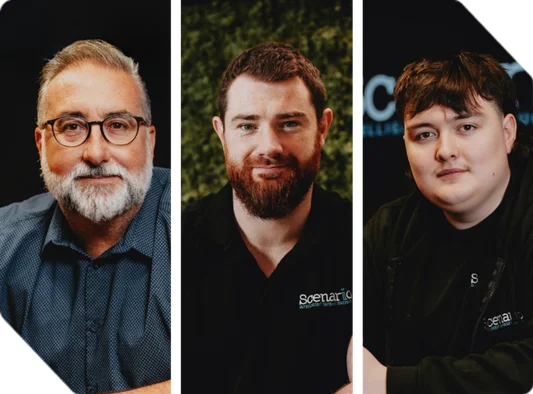
George Euston
George, our youngest team member, has successfully completed his 12-month apprenticeship and now joins the business as a permanent member of the team in a Technical Support role. Over the past year, he has developed into a dependable part of the support function, showing a strong willingness to learn and contribute. His progression reflects our commitment to developing talent from within and building long-term capability.
Conor Taylor
Conor steps into the role of Technical Manager, bringing with him a depth of technical knowledge and a clear understanding of how Scenariio delivers its projects. He will lead the continued development of the technical team, ensuring the high standards our customers expect are maintained as we take on increasingly complex work. His approach combines practical experience with a focus on continuous improvement.
Lee Taylor
Lee joins the senior management team as Commercial and Sales Director, working closely with the Managing Director to guide the next phase of the business. With a strong understanding of Scenariio’s culture and offering, Lee will focus on strengthening client relationships, developing new opportunities and shaping how we present our services externally.
Commenting on his new role, Lee said:
At the heart of every leading company is a strong sales culture. It’s something you can see across the whole business, not just in strategy. By championing what we do and how we do it, we create the opportunity to deliver the work we’re known for and continue to grow.”
Together, these changes mark an important step in Scenariio’s development, strengthening the team while staying true to the principles that have shaped the business so far.
In case you haven’t read our recent Insiight article, we’ve taken the opportunity to reflect on what has been our most successful year to date. Members of our leadership team share their perspectives on 2025: from the challenges we faced to the milestones we achieved, and what they mean for the future of Scenariio. It offers a candid look at the journey behind the growth and the direction we’re continuing to build towards.
Digital Communication Screens in Manufacturing Sector
News & Insights
Digital Communication Screens in Manufacturing: from Visibility to Real-Time Performance..
You can’t manage what you can’t see.
In food and drink manufacturing, where processes are tightly controlled and margins are under pressure, visibility is critical. Yet many sites still rely on fragmented communication, manual reporting and delayed insights.
Digital communication screens are changing that. Not as standalone displays, but as part of a connected, real-time operational environment.
Published
Monday, 30th March 2026
Category
News & Insights
TAGS
Insights
Turning data into action on the shop floor
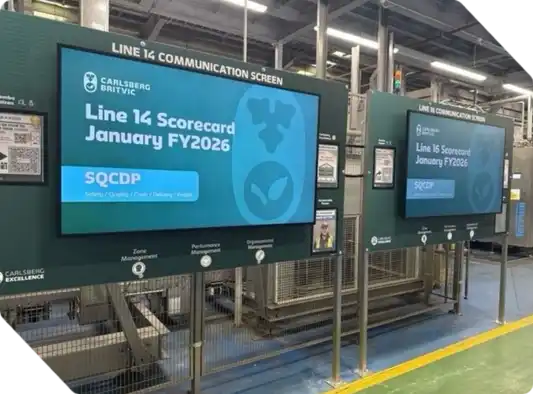
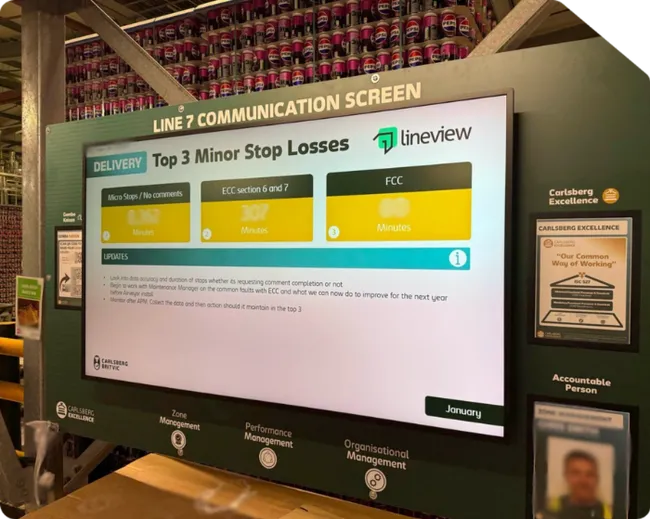
At Carlsberg Britvic, digital communication screens were deployed across the production environment to support a move towards a more connected, data-led operation.
Each screen provides real-time visibility of:
- KPIs and performance scorecards
- top losses and inefficiencies
- ongoing improvement initiatives
- daily operational updates
All structured around the SQCDP framework: Safety, Quality, Cost, Delivery and People.
This creates a shared view of performance across teams and shifts. More importantly, it enables faster, informed decision-making at the point of work.
From digital signage to smart factory integration
The real value of digital communication screens comes from integration. When connected to wider systems such as MES, IoT platforms or building infrastructure, screens become more than displays. They act as a live interface between data and people.
This enables:
- automated data feeds from production systems
- real-time updates without manual input
- consistent communication across lines and sites
- scalable deployment as operations grow
For facilities and IT teams, this shifts screens from isolated installations to part of a connected digital ecosystem.
Driving operational efficiency and continuous improvement
In manufacturing, visibility drives behaviour. By making performance data visible to everyone, digital communication screens support faster identification of issues, improved accountability across teams, alignment between departments and continuous improvement initiatives. For continuous improvement teams, visualising top losses and tracking progress daily is critical. For operators, it provides clarity on priorities during the shift.
The result is a more responsive, data-driven operation.
Avoiding “white noise”: making screens part of daily operations
A common concern with digital communication screens is that they risk becoming background noise. In some environments, screens are installed with good intent but fail to influence behaviour. Over time, teams stop engaging with them and the value is lost. The difference comes down to how they are embedded into daily operations.
At Carlsberg Britvic, the screens are structured around SQCDP, which already underpins how teams review performance on the shop floor. Rather than introducing new layers of information, the screens reinforce what matters, making it visible, consistent and real time.
To ensure the information remains relevant and actionable:
- content is specific to each production line or area
- data is live, allowing teams to see changes during the shift
- screens are positioned where team discussions naturally take place
- they support daily huddles and reviews, rather than replacing them
When digital communication screens become part of the operating rhythm, they shift from passive displays to practical tools that support decision-making on the floor.
Digitalisation in UK manufacturing: from pilot to scale
Digitalisation in UK manufacturing is not a new concept. Programmes such as Made Smarter began as regional pilots in 2018, demonstrating the value of technologies including real-time data, IoT and connected systems. Since then, the focus has shifted from experimentation to national rollout and wider adoption.
Today, that rollout is accelerating. Government-backed programmes are expanding across all English regions by 2025–26, with further UK-wide adoption expected beyond that. For manufacturers, the priority is no longer whether to adopt digital tools, but how to embed them into day-to-day operations at scale. In this context, digital communication screens play a practical role. They ensure that data generated across systems is visible and usable on the shop floor.
The Scenariio approach
At Scenariio, digital communication screens are delivered as part of a wider, integrated solution. This means aligning AV, network and data infrastructure, integrating with existing production and building systems and designing for scalability across sites. The focus is on creating a communication layer that supports operational performance.
Conclusion
In food and drink manufacturing, digital communication screens are a practical tool for improving visibility, driving performance and enabling real-time decision-making. As manufacturing continues to digitalise, their role will become more central. Not as standalone technology, but as part of how modern factories operate.
FAQ
Digital communication screens are strategically placed displays across the factory floor that provide live operational data, performance metrics and team communication.
In modern manufacturing environments, they sit at the intersection of digital signage, production systems and smart factory infrastructure.
Their role is simple. Make critical information visible, consistent and actionable.
Digital signage is often used for general messaging or corporate communication.
Digital communication screens in manufacturing are typically integrated with operational systems and display live production data.
They can integrate with systems such as:
- MES (Manufacturing Execution Systems)
- IoT platforms
- ERP systems
- building or infrastructure platforms
Integration enables automated, real-time updates.
Key benefits include:
- improved visibility of performance
- faster decision-making
- better team alignment
- support for continuous improvement
- more consistent communication across shifts.
Screens can become ineffective if:
- content is not relevant to the audience
- data is outdated or manual
- they are not used in daily routines
- there is no ownership of the content
Embedding them into existing processes is critical. Speak to us if any of these is your concern.
Yes. They can support compliance by reinforcing safety, hygiene and quality messaging in real time and ensuring consistent communication across teams.
There are no strict mandates, but programmes such as Made Smarter are accelerating digital adoption across manufacturing, supported by funding and advisory initiatives.

Protecting IT Infrastructure in Modern Estates with Scenariio
News & Insights
Planning for Failure: When Your IT Infrastructure is the One Most Worth Protecting.
Modern IT infrastructure is more resilient than it has ever been. Networks are faster, hardware is more reliable and systems are increasingly monitored in real time. Yet outages, performance issues and failures still happen, often in well-designed, professionally installed environments.
Published
Monday, 2nd February 2026
Category
News & Insights
TAGS
Insights
That is precisely why IT infrastructure is the one asset most worth protecting.
Where things still go wrong
Even in high-quality estates, issues tend to fall into a few predictable categories.
- Complexity and interdependence: IT, AV and smart building systems are now tightly connected. A fault in one layer, whether power, network switching, firmware or cloud services, can cascade quickly across multiple services.
- Change over time: Buildings evolve. Tenants change, layouts are reworked, devices are added and removed. Documentation drifts, and small configuration changes accumulate until something breaks under load.
- Silent degradation: Many failures are not sudden. Performance drops, packet loss increases or devices fall out of compliance. These issues often go unnoticed until they affect users or tenants.
- External factors: Power fluctuations, ISP issues, supplier outages and cyber incidents can all impact otherwise well-maintained systems, particularly across multi-site estates.
The risk for estates and landlords
For organisations that own and operate their estates, downtime directly affects productivity, safety and reputation. For landlords and managing agents, the risks extend further.
Service disruption can breach lease expectations, affect multiple tenants at once and place additional pressure on facilities and property teams. In the UK, this sits alongside rising expectations around building performance, resilience and compliance.
Why support and maintenance matter
Support and Maintenance focuses on reducing the likelihood, impact and duration of issues when they inevitably occur. A structured service provides proactive monitoring, faster fault identification, clear ownership across IT, AV and smart systems and accurate documentation as environments evolve. It ensures infrastructure is actively looked after throughout its lifecycle.
Planning for continuity, not perfection
No infrastructure is immune to failure. What matters is having the right people, processes and visibility in place before an issue becomes a disruption. When infrastructure underpins every building service, tenant experience and compliance obligation, it becomes the asset most worth protecting, not because it is weak, but because so much depends on it.
Protect the infrastructure you rely on
Our Support and Maintenance services provide proactive monitoring, clear ownership and ongoing care across IT, smart building and AV systems. Designed for estates that need confidence, continuity and control.
Talk to us about Support and Maintenance annual packs, contact us: info@scenariio.com
This article was originally published on our LinkedIn profile on 2nd February (click here to read the article) .